Contextual Nudges
Nudges and Reinforcement Triggered
by Behavior, Not Calendar Dates
Lorem ipsum dolor sit amet, consectetur adipiscing elit, sed do eiusmod tempor incididunt
ut labore et dolore magna aliqua. Ut enim ad minim veniam, quis nostrud exercitation ullamco.
(OLD VS NEW)
How Tigerhall Turns Change
Into Behavior That Lasts
Lorem ipsum dolor sit amet, consectetur adipiscing elit, sed do eiusmod tempor incididunt ut labore et dolore magna aliqua.
Ut enim ad minim veniam, quis nostrud exercitation ullamco.
Traditional Comms
Lorem ipsum
One size fits all email blasts
The same for everyone
Detached from real workflows, multiple platforms
Too early, too late, or irrelevant
Nudging Employees at the Right Time
Lorem ipsum
Personalized by role, behavior, and adoption stage
Triggered in real time by employee actions
Reinforcement tailored to specific moments of need
Automated targeting and delivery
(THE "WHAT") - need to rethink design of this section
Move From Time-Based Change
to Behavior-Based Change
Lorem ipsum dolor sit amet, consectetur adipiscing elit, sed do eiusmod tempor incididunt ut labore et dolore magna aliqua. Ut enim ad minim veniam, quis nostrud exercitation ullamco.
Workflow Based
Fire Nudges Based on What People Did in the Org's Core Tools
Highly specific actions in the systems your employees actually work in — Salesforce, Workday, SAP, ServiceNow, Copilot, custom CRMs. The biggest, most common source of trigger signal.
Examples
Started a CPQ approval for the first time
Completed a procurement workflow 10 times this week
Hasn't submitted a timesheet by Friday noon
Pressed the wrong button in S/4HANA
Response Based
Fire Nudges Based on People's Sentiment and What They've Said
Direct signals from how employees responded to a quiz, pulse check, knowledge test, or sentiment slider. The "voice of the workforce" signal — captured continuously, not in an annual survey.
Examples
Scored below 6 on an AI readiness assessment
Answered a knowledge check incorrectly
Selected "skeptical" on a sentiment pulse
Reported low confidence on this week's check-in
Fire Nudges Based on Their Change Activity
How employees actually behaved around your content — what they engaged with, what they skipped, what they shared, what they came back to. The signal that catches "fake engaged" and surfaces hidden champions.
Examples
Dropped off halfway through a video
Hasn't opened anything in 14 days
Forwarded a podcast to three colleagues
Replayed the same power read four times
Negative Based Scenarios
Fire Nudges Based on Inaction or Negative Workflows
How employees actually behaved around your content — what they engaged with, what they skipped, what they shared, what they came back to. The signal that catches "fake engaged" and surfaces hidden champions.
Examples
Doesn’t do something (inaction)
Reminders fire before disengagement hardens; creating urgency to complete pending actions.
Exhibits resistance/submits negative feedback
Prevent escalation with timely reinforcement (like content that builds confidence) and updated messaging.
Drops below adoption/engagement threshold
Reengagement tactics deployed to bring people back on track.
Registers a workflow error
Refreshers deliver instantly so errors don’t pile up and become a habit (much harder to curb).
(EXAMPLE OF HOW IT WORKS) (NEEDS DESIGN)
Same Team, Same Initiative,
Different Journeys
Same team. Same initiative. Three completely different journeys
— because the trigger is the behavior, not the date.
Jessica
Finance Executive
(pre-launch confidence: 3)
Albert
Finance Executive
(pre-launch confidence: 8)
Monica
Finance Executive
(pre-launch confidence: 6)
Day 0 → Confidence-builder fires first.
"Why Finance is leading this change"
Day 0 → Skips confidence-building.
Straight to enablement.
"Your First Invoice in the New System."
Day 0 → Receives standard
enablement sequence.
“What’s Changing in AP Workflows”
Day 3 → Starts first AP workflow
*Triggers enablement*
"Your First Invoice in the New System"
Day 5 → Completes AP workflow daily,
no errors
*triggers champion prompt *
"You've hit a perfect 5-day streak in S/4HANA
— share your experience."
Day 7 → Misses required workflow
steps twice
*triggers corrective reinforcement*
“Common AP Approval Mistakes
and How to Avoid Them”
Day 14 → No workflow activity for 10 days
*triggers re-engagement nudge*
“It’s been a while — here’s a quick refresher before month-end close.”
Jessica Gets Confidence-Building Before Resistance Slows Adoption
Lorem ipsum dolor sit amet, consectetur adipiscing elit, sed do eiusmod tempor incididunt ut labore.
Albert Isn’t Slowed Down by Unnecessary Reinforcement
Lorem ipsum dolor sit amet, consectetur adipiscing elit, sed do eiusmod tempor incididunt ut labore.
Monica Gets Corrective Support Before Bad Habits Stick
Lorem ipsum dolor sit amet, consectetur adipiscing elit, sed do eiusmod tempor incididunt ut labore.
Context is the only thing that turns information into intelligence
— and intelligence into action.

Mike Ackermann
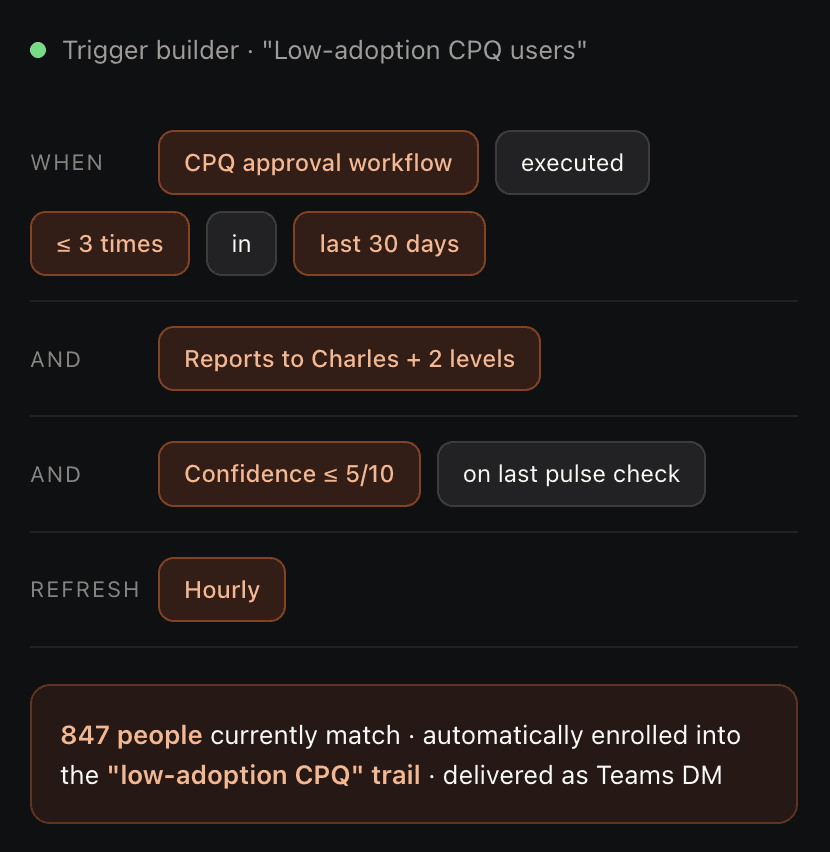
(Show how to build automated triggers)
The Conditions Get
as Granular as the
Initiative Demands
Every signal is composable. Combine workflow events with time windows, demographic filters, and response thresholds. The system re-evaluates continuously — the moment someone meets the criteria, the trigger fires. The moment they no longer meet it, the trigger stops. No spreadsheet. No manual list-keeping.
By System
Lorem ipsum dolor sit amet, consectetur adipiscing elit, sed do eiusmod tempor incididunt.
By Event Type
Lorem ipsum dolor sit amet, consectetur adipiscing elit, sed do eiusmod tempor incididunt.
By Latency
Lorem ipsum dolor sit amet, consectetur adipiscing elit, sed do eiusmod tempor incididunt.
By Delivery Channel
Lorem ipsum dolor sit amet, consectetur adipiscing elit, sed do eiusmod tempor incididunt.
(Show how it works with persona groups)
One Trigger Engine,
Different Experiences
Per Persona
Different persona groups experience change differently — so reinforcement shouldn’t be one-size-fits-all. Tigerhall lets you build contextual triggers and conditions around the unique behaviors, risks, confidence levels, workflows, and adoption patterns of each persona group.
(Show Examples)
(ALWAYS-ON ADAPTATION)
Reinforcement Across
the Entire Change Journey
Same team. Same initiative. Two completely different journeys
— because the trigger is the behavior, not the date.
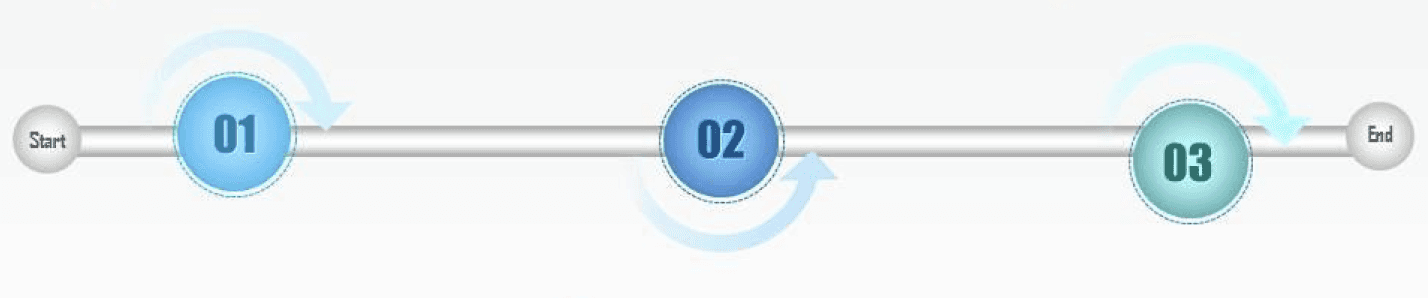
Before Go-Live
Identify resistance and confidence gaps before adoption breaks down
After Go-Live
Sustain adoption automatically without manual follow-up
During Go-Live
Reinforce behaviors directly inside workflows
Why This Matters
A single trigger isn't a feature — it's a closed loop that the system runs continuously,
on every employee, across every initiative. Here's the loop in flight.
Automated reinforcement at scale
Lorem ipsum dolor sit amet, consectetur adipiscing elit, sed do eiusmod tempor incididunt ut labore.
Real-time interventions
Lorem ipsum dolor sit amet, consectetur adipiscing elit, sed do eiusmod tempor incididunt ut labore.
Adoption that sticks
Lorem ipsum dolor sit amet, consectetur adipiscing elit, sed do eiusmod tempor incididunt ut labore.
Increase Adoption Velocity
Lorem ipsum dolor sit amet, consectetur adipiscing elit, sed do eiusmod tempor incididunt ut labore.
Sustain Adoption Beyond Go-Live
Lorem ipsum dolor sit amet, consectetur adipiscing elit, sed do eiusmod tempor incididunt ut labore.
Scale Personalized Change
Lorem ipsum dolor sit amet, consectetur adipiscing elit, sed do eiusmod tempor incididunt ut labore.
(Show how this feeds into data in real-time and makes the next initiative better)
Compounding intelligence
The triggers provide data on what works and what doesn’t, what actually drives adoption
— informs future strategy, refines execution.
Format vs. Adoption
Which format actually drives reengagement?
Does a 2-minute video after a workflow error produce faster correction than a power read? The data shows which format drives reengagement for which persona.
Timing vs. Completion
How fast does the trigger need to fire?
Content delivered within an hour of a trigger fires at significantly higher completion rates than the same content delivered the next morning.
Trigger condition vs. Outcome
Which leading indicator most reliably predicts adoption?
Which leading indicator most reliably predicts full adoption for this persona group — low readiness score, content drop-off, or inactivity? Patterns emerge across the portfolio that inform how you set trigger logic for future initiatives.
The Silent Signal
What it means when a trigger fires and nothing happens.
Content delivered within an hour of a trigger lands at significantly higher completion rates than the same content delivered the next morning. The latency that matters varies by persona — and the data tells you exactly where.
This is where in-house capability is actually built — by reading silence, not by celebrating opens.
What This Means For Your Team
Instead of relying on central teams to manually monitor adoption, segment audiences, and deploy follow-ups, Tigerhall continuously orchestrates personalized reinforcement automatically across every initiative.
Because adoption doesn’t happen at launch. It happens in the moments employees actually work.
Manual → Autonomous
Lorem ipsum dolor sit amet, consectetur adipiscing elit, sed do eiusmod tempor incididunt.
Scheduled → Behavioral
Lorem ipsum dolor sit amet, consectetur adipiscing elit, sed do eiusmod tempor incididunt.
Reactive → Predictive
Lorem ipsum dolor sit amet, consectetur adipiscing elit, sed do eiusmod tempor incididunt.
One-time → Continuous
Lorem ipsum dolor sit amet, consectetur adipiscing elit, sed do eiusmod tempor incididunt.