Change Activation
Overview
This roundtable focused on a practical problem most transformation leaders face: how to manage a growing portfolio of initiatives with limited capacity, competing executive demands, and inconsistent business cases. The core theme was “ruthless prioritization” as a discipline: using a transparent, data-driven method to reduce politics and emotion, make trade-offs explicit, and protect limited transformation capacity.
Two complementary threads emerged:
A structured prioritization approach (criteria, weights, and operational definitions) to rank initiatives consistently.
The “real world” constraints that make prioritization hard (culture, influence, shifting strategy, weak data, and unfunded work) plus tactics to make the model stick.
This roundtable was held on February 4th, 2026.
Roundtable Participants
Led by Jackie Cazar, Moody's - SVP Process Excellence
Adolfo Carreno, Citi - Vice President, Transformation Program Management
Akita Somani, U.S. Bank - SVP, Director – Inclusive Growth Strategy
Ana Coronel, Independent - Transformation Executive
Andrew Spector, Paramount - Former Senior Director, Change Management
Antoinette Roach Powell, Fannie Mae - Chief of Staff
Beverly Troxtell, Pacific Life - AVP (Sr Director), Enterprise Change Management
BJ Ramos, Xylem - Director, Organizational Change Management for IT
Brian Hricik, Sherwin-Williams - Change Management Lead
Carolyn Chong, Amazon - Head Deal Success & Change Management
Kevin Chanashing, Bank of America - Executive SVP, Transformation Strategy
Christy Didion, Crawford & Co - Organization Change Management and Transformation Lead
Christy Renier, Plexus - Sr Manager, Enterprise Transformation
Dane D'Alessandro, Bank of America - SVP, Change Management
David Stein, VML - SVP, Performance Marketing Operations
Derek Gallo, Thermo Fisher - Sr. Director, Business Transformation
Desiree Duarte, IQVIA - Communications & Change Lead
Eric Schantzenbach, ChristianaCare - Former Vice President Change Leadership
Erica Howard, TIAA - Former Managing Director, Office of the CAO - Head of Strategy Deployment & Governance
Evan Piekara, Nestle - Former Director, Change Management
Grégoire de Chevron Villette, RONA - Former Head of Transformation
Harshini Gadam, Staples - Transformation Finance Lead
Ian Brodie, John Hancock - Global Head of Retirement Transformation
Jeffrey Fisher, Wipro - Senior Director
Jenifer Spurgeon, GE Appliances - VP/Director Operations
Jessica Cormier, BPM - Transformation Strategist
Joseph McMahon, Northwell Health - VP, Change Management
John Nolan, City National Bank - SVP Strategic Change
Kathy Comfort, Thoughtworks - Global Head of Strategic Activation
Katy Liddell, Liberty Utilities - Senior Director, Organizational Change Management
Kelly Long Jackson, Ogilvy - Director, Change Management Strategy
Kitty Deshmukh, Daimler Truck North America - Former Director of Continuous Improvement, PMO
Lisa Jeffreys Duncan, Premise Health - SVP, Head of Enterprise Transformation
Margi Moscoe, Fortitude Re - Vice President, Change Management
Mike Boswell, Breakthru Beverage Group - Vice President - Digital and eCommerce
Melissa Harris, BCBS - Senior Director, Transformation Office
Michael Goldman, Patterson Dental - Sr Director - Business Transformation
Michelle Rivera-Spann, Informa - Vice President, Global Inclusion
Norma Mendez, Enbridge - Change Management Lead
Olya Taran, Manulife - AVP, AI Adoption, Talent, Culture
Paul Ruggier, Helios Towers - Group Head of Business Excellence
Rodion Rogov, JLL - Account COO and Global Centre of Excellence Lead, Financial Services
Sharon Daniels, BT Group - Transformation Change Management & Internal Communications
Stephanie Coleman, Sodexo - Program and Transformation Office, Senior Director
Tom Langemo, United Health Group - Senior Director, People M&A | Culture, Experience, & Measurement
Vanessa McDonald, WNS Global - SVP Change Management
Vanessa Hammett, Change & Communications Independent Consultant
Wes Herzik, JP Morgan - Executive Director, AI Orchestration & Change Management
The Core Challenge: Limited Resources vs. Unlimited Demand
Participants agreed that balancing constrained resources against a long list of initiatives is inherently difficult, especially when:
Different executives push conflicting priorities.
Regulatory/compliance work competes with growth or productivity agendas.
Teams inherit large backlogs of “already-started” projects.
New leaders reset strategy and expectations midstream.
A recurring point: without a shared method, prioritization becomes a negotiation driven by the loudest voice, the most polished deck, or the most urgent stakeholder.
“Even when everyone comes in with an ROI, it doesn’t solve everything automatically. Each project is presented as a top priority, each one has a polished story, and we’re still left trying to figure out what’s real and what’s just a different set of assumptions.”
John Nolan, City National Bank - SVP Strategic Change
The Prioritization Model: From Intake to Ranked Portfolio by Jackie Cazar
Build a small set of prioritization criteria
The group discussed keeping criteria focused (often 5 or fewer) to avoid complexity while still reflecting what matters most. Common criteria referenced included:
Productivity/capacity creation
Financial value/ROI
Customer or end-user impact
Growth outcomes
Risk and compliance considerations
Additional “enablers” were also highlighted as useful criteria in certain contexts:
Data readiness/quality (especially for AI-enabled initiatives)
Organizational readiness/maturity
Scope and scale (enterprise vs. function vs. region)
Complexity or level of effort
Weigh the criteria to reflect the current strategy
Give a weight to each criterion in the list (between 3 and 10, 3 being the lowest priority criterion and 10 being the highest) based on your current organization's priorities.
A key best practice: weights should mirror current strategic intent and they should change when strategy changes. They are also different from organization to organization.
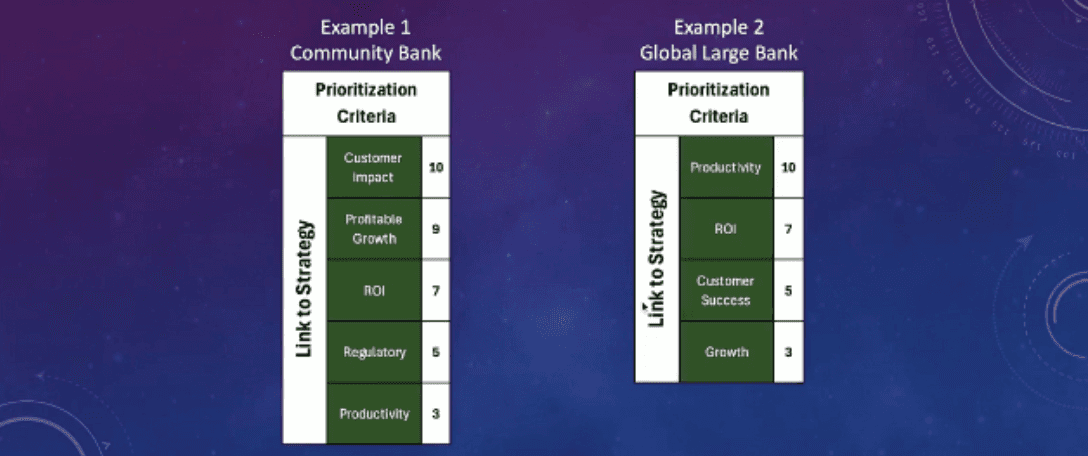
In these examples, the community bank has as its highest priority customer impact while the global large bank is currently focused more on productivity.
3. Define “high/medium/low” with operational definitions
Operational definitions are critical to proper prioritization: you need clear, agreed descriptions of what “high,” “medium,” and “low” mean for each criterion.
Why it matters:
Leaders often label every initiative “top priority” unless forced into comparable definitions.
Business cases are frequently inconsistent, making apples-to-apples comparison impossible.
Definitions reduce room for debate after the fact because stakeholders have already agreed to the scoring rules that follow.
Following the example of the “Global Large Bank” above, here are some operational definitions for each criterion:
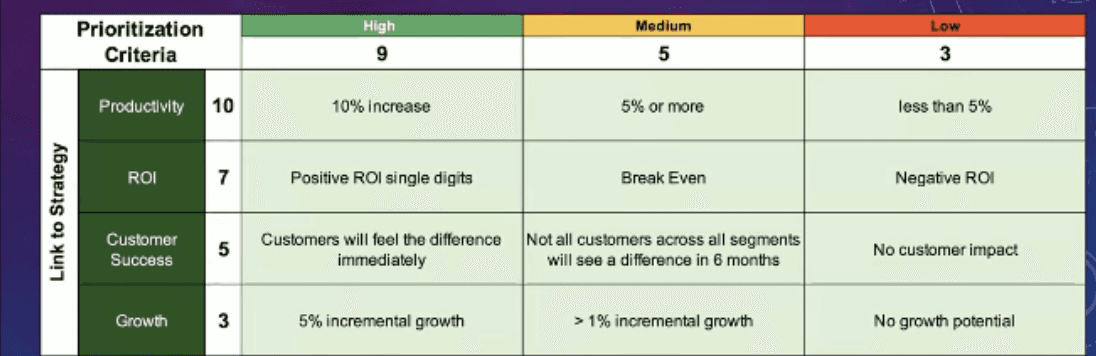
For this bank, a ‘10% increase in productivity’ would mean scoring high in the productivity criterion.
Use a simple scoring calculator to rank initiatives
Step 1: List all initiatives in a spreadsheet
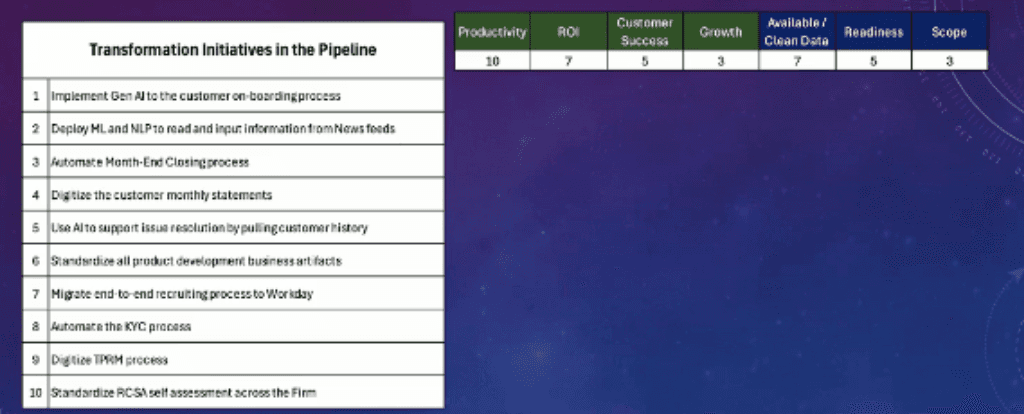
Step 2: Score each criterion as high/medium/low for each initiative (i.e. does this initiative score high, medium, or low in productivity as operationally defined?)
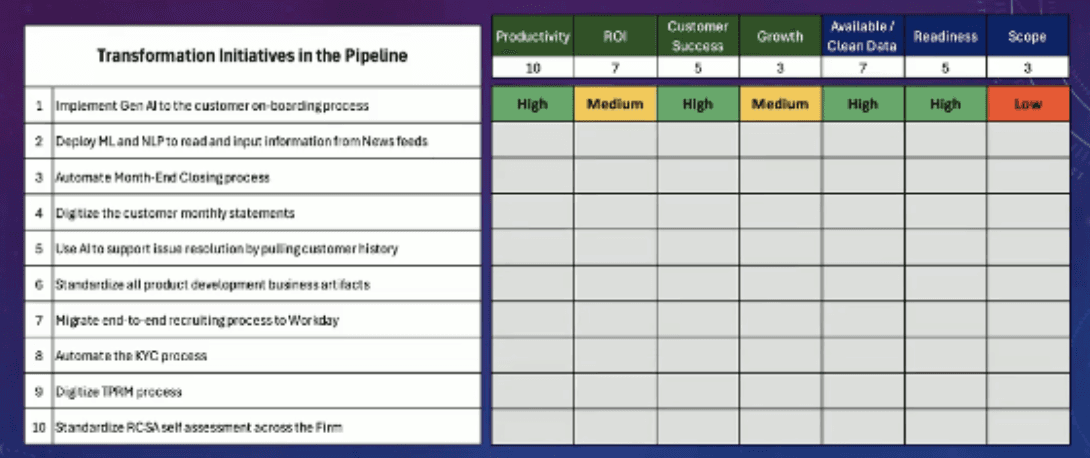
Step 3: Convert each high, medium, low into numbers (high=9, medium=5, low=3)
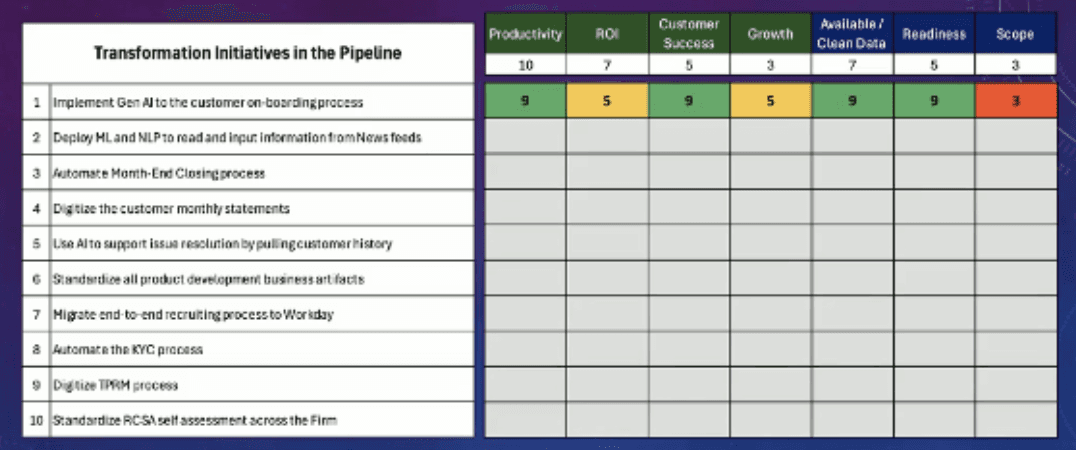
Step 4: Multiply each of the high, medium, low numbers with its corresponding criterion value and then add them up together into a total initiative score
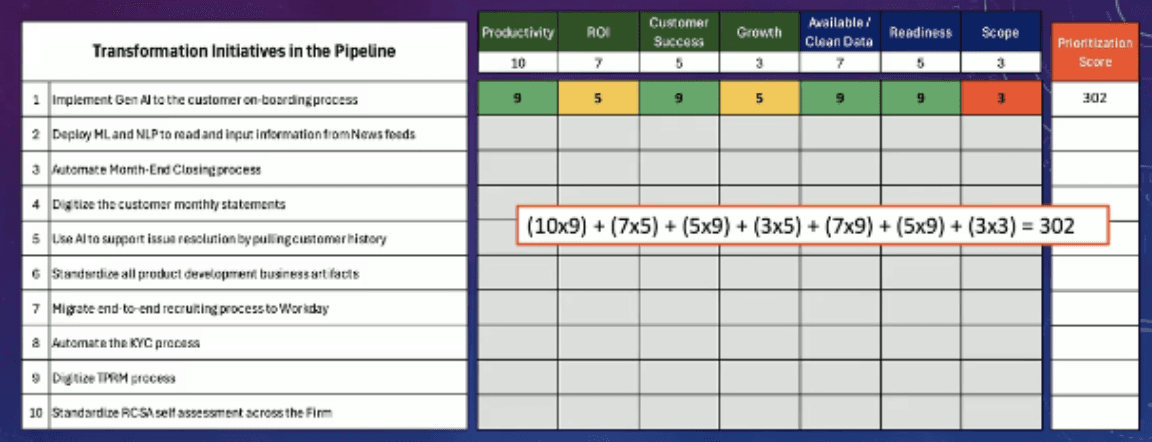
Step 5: Calculate the prioritization score for all of your initiatives and then rank them, from highest score to lowest
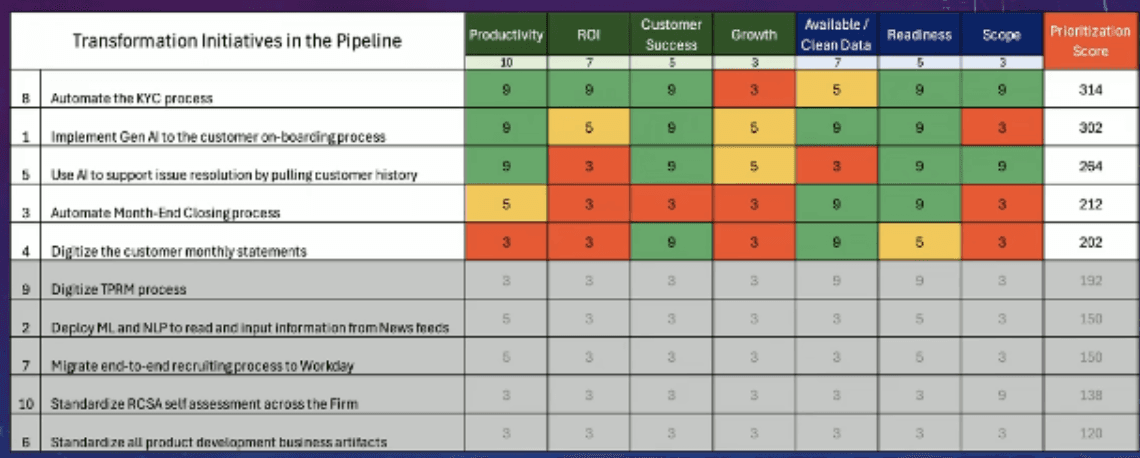
This removes the emotion and politics from decision-making by reducing subjective debate and making trade-offs defensible: each initiative has a number and the highest number wins.
Other than co-creating the criteria and operational definitions with senior stakeholders, then treating them as the “rules of the game”, other tactics were also brought up by participants:
Use governance to ensure challenge comes from peers, not only from the transformation office (reduces the “bad cop” dynamic).
Assign explicit roles in governance (e.g., independent validators, devil’s advocate) to pressure-test assumptions.
“Sometimes, you have to question the data that’s put in front of you and the true ROI of a transformation. When everyone has a different project that’s important to them, have an independent person come in and pressure test the data based on their field knowledge. You’ll find that a stakeholder’s assumptions might not truly translate to the results they are hoping to drive and you then have a neutral party shed light on the situation.”
Eric Schantzenbach, ChristianaCare - Former Vice President Change Leadership
Managing Complexity: One Big Bet vs. Many Smaller Wins
A nuanced question surfaced: should leaders choose one high-scoring, high-effort initiative or multiple smaller initiatives that collectively deliver more value?
The group’s direction:
Use the scoring model to inform the conversation, not replace it.
Add complexity/effort and risk as explicit lenses so “high score” doesn’t automatically mean “do now.”
Look for bundling opportunities where several lower-priority items combine into a stronger, more coherent case.
Recognize that some low-priority work can unlock capacity for higher-priority work.
Data Quality and the “Bad Business Case” Problem
A major pain point: initiatives arrive with weak or inflated claims (especially around productivity/AI), unclear baselines, or missing measurement plans.
Best practices discussed:
Establish baseline metrics before approving value claims.
Make sponsors answer: “What will be different when this is done?”
Treat value realization as a staged validation process with multiple checkpoints, not a one-time promise.
Partner closely with finance leadership to define how benefits are validated and when they can be counted.
A related insight: the spreadsheet is easy; the rigor of definitions, baselines, and validation is where prioritization succeeds or fails.
“You can’t compare initiatives if the inputs aren’t real. So you do the hard work upfront: time studies, baseline data, and a consistent way to validate benefits across the pipeline.”
Jackie Cazar, Moody's - SVP Process Excellence
Funding, Capacity, and the Reality of “Unfunded Priorities”
Participants raised a common pattern: initiatives that are labeled a “priority” without clear budget that pull people into shadow work.
Approaches discussed:
Require a business case as part of intake, including accountability for costs and benefits.
Use portfolio management practices to evaluate initiatives during annual planning and budgeting.
Consider gating mechanisms early in idea generation to prevent central teams being pulled into low-priority work.
Separate committed work from aspirational work to protect delivery focus.
Provide small “test-and-learn” or proof-of-concept funding to validate ideas before scaling.
Culture and Leadership Dynamics: When the Model Doesn’t Stick
Prioritization frameworks can fail in cultures where:
Consensus is required for everything.
The organization is well-resourced and defaults to “yes” rather than trade-offs.
Influence and politics override agreed criteria.
Practical mitigations discussed:
Make the intake process start with a clear threshold to be considered.
Use governance design (who is in the room, who challenges, how decisions are documented).
Build mechanisms to stop or reset initiatives when assumptions no longer hold (avoid sunk-cost continuation).
Sanity-check priorities with frontline or end-user networks to validate real impact.
Key Takeaways
Prioritization is a portfolio discipline, not a one-off ranking exercise. It needs intake standards, governance, and periodic recalibration.
Operational definitions are the real unlock. Agreeing what “high/medium/low” means for your organization prevents every initiative from being scored as “critical.”
Weights must mirror strategy and change when strategy changes. The model should evolve with market conditions and leadership direction.
No data, no priority. Strong intake requires baselines, measurable outcomes, and accountability for value.
Finance partnership is essential. Value claims need a shared validation approach and staged sign-offs, not optimistic assumptions.
Culture can break the framework. Governance design and decision discipline matter as much as the spreadsheet.
Make trade-offs explicit. Separate committed vs. aspirational work, gate early, and be willing (& ready) to stop initiatives when conditions change.
Balance score with feasibility. Incorporate effort, risk, readiness, and capacity so the “top-ranked” work is also deliverable.
The Executive Council for Leading Change
The Executive Council for Leading Change (ECLC) is a global organization that brings executives together to redefine the landscape of organizational change and transformation. Our council aims to advance strategic leadership expertise in the realm of corporate change by connecting visionary leaders. It's a place where leaders responsible for significant change initiatives can collaborate, plan, and create practical solutions for intricate challenges in leading large organizations through major shifts.
In a world where change is constant, we recognize its crucial role in driving business success. ECLC’s mission is to create a community where leaders can excel in guiding their organizations through these dynamic times.